


Blood Camp Thatcher (1982)

"In the year 2000, the game is hunting and people are the prey!"

Plot
In the near future, ‘social deviants’ are held in a maximum-security camp where the sadistic leader organise "turkey hunts" where wealthy individuals pay him money to hunt prisoners for sport. A bunch of new arrivals find conditions at the camp brutal and harsh but are offered a chance of freedom if they survive this year's hunt.
Review
During the 70s and 80s, the Australian film industry was undergoing its Ozploitation phase. This was a category of low-budget horror, comedy, sexploitation and action films made in Australia after the introduction of the r-rating in 1971. Think of the likes of Razorback, Howling III and Road Games amongst a few of the films that I’ve reviewed on here as well as the Mad Max series and you get a sense of the type of offerings that were being given up, helped by some generous tax exemptions courtesy of the Australian Film Commission. Blood Camp Thatcher, also known as Turkey Shoot or Escape 2000), was a dystopian action Ozploitation film which followed the same idea of casting international stars alongside homegrown soap veterans and character actors to try and sell to European and US markets. Lots of British horror and sci-fi films did the same back in the 50s and 60s and now it was the Aussie’s turn to come up with something that might not be overly famous to mainstream audiences but has become a big cult hit, championed by the likes of Quentin Tarantino.

Blood Camp Thatcher is set in the near future, and society has become completely degenerate. Within this harsh, unforgiving world, people who are deemed social deviants are rounded up and held in a brutal, maximum-security prison camp. The conditions are incredibly harsh for any new arrivals, but the core conflict of the film hinges on the camp's sadistic leader. He organizes these annual events called turkey hunts. Wealthy individuals pay this leader money for the privilege of hunting the prisoners for sport. And the grim bargain offered to the inmates is this. If they manage to survive this year's hunt, they get a chance at freedom. Blood Camp Thatcher acts as a kind of updated version of the 1932 classic film, The Most Dangerous Game. For those unfamiliar, that 1932 film is really the granddaddy of the hunting humans for sports genre. Every piece of media that uses this trope owes a debt to it. But unlike some of the more polished or mainstream takes on this concept, this particular Australian export leans heavily into the sleaze.
The sleaze, the tone, the entire vibe of Blood Camp Thatcher wasn't necessarily what the filmmakers originally set out to create. There was a massive behind the scenes hiccup, right at the very last minute as a major financial backer pulled out of the film. The ripple effect of losing that money was wild. They literally had to take the first fifteen pages of the script and just throw them away to save on budget and production time. That single financial setback changes the entire experience for the audience. What usually happens in the first fifteen pages of a script for a sci-fi film. That is your world building portion. That's where the writers explain the political climate, the societal collapse, the reasons why things are the way they are – literally the entire set-up. Because those pages were trashed, the audience gets absolutely zero explanation for how this future world became so degenerate. There's nothing in the narrative to explain what is going on outside the fences of this camp. The audience is forced to accept the fact that this is the future and it isn't pretty. The film was to have originally started out as this well-meaning but Orwellian vision of the future. Serious social commentary, themes of authoritarianism, state surveillance, the loss of individual rights – you get the idea. It had these real visions of grandeur. Without a proper first act to anchor the futuristic setting to any real societal critique, the futuristic elements become totally irrelevant. There's no social commentary left to be had. All of the high-minded sci-fi aspirations went and instead, Blood Camp Thatcher headed off to become a straightforward exploitation film.

The film is pretty slow to get its gears moving at first. The early scenes in the prison camp feel incredibly derivative of a very specific schlocky genre - these sequences could have been culled directly from any of those sleazy European semi-porn prison camp films that were popular in underground markets at the time. We’re talking gratuitous shower scenes, exaggeratedly harsh conditions, and a generally grimy aesthetic that really wallows in the exploitation genre before the main plot even gets going. It’s a slow burn of sleaze, basically relying on cheap thrills because the deep story is missing. But eventually, the wealthy hunters arrive, the gates open, and the turkey shoot begins. When the prisoners are released into the wild, the film undergoes a radical structural shift. They scatter in complete panic, go in their own separate ways with every man for himself. Because of that choice to have them scatter, the film suddenly breaks into five separate pursuits, all running simultaneously alongside each other. From a storytelling perspective, Blood Camp Thatcher balances the five different chases without becoming a confusing mess well. From a pacing and editing standpoint, it is a brilliant, albeit chaotic, choice. The film cuts nicely from one chase sequence right into the next. You don't have time to get bored, because the moment one character is cornered, the editor cuts to another character in a completely different life-or-death situation which keeps the adrenaline up. This relentless structure means the film suddenly picks up its pace and literally never lets up until the very end. It cycles through the survivors, escalating the tension, culminating in one character being killed off before the cycle starts again. And when someone gets caught, you can be a little surprised at how outrageously gratuitous it gets. Toes are bitten off. Heads are blown up. Eyes are impaled. People have their hands completely cut off. There is general dismemberment scattered throughout the chase scenes. You name it, it's here. It is an absolute bloodbath.
This extreme level of gore had massive real-world consequences for the film's distribution as Blood Camp Thatcher had such patchy, inconsistent releases across the world. It specifically fell victim to the notorious BBFC butchers in the UK - the British Board of Film Classification. During the 1980s, the UK went through a massive moral panic regarding what they called video nasties, or ultraviolent films which were being released on VHS. The BBFC was infamous for heavily censoring, cutting, or outright banning films for this kind of content. Even though it was heavily censored by official boards, the gore itself is so unbelievably over the top that it bypasses being genuinely offensive. It crosses a line from being disturbing straight into the realm of the absurd. It shifts the film from being just a dull, rather sinister little exploitation flick into an enthusiastic cheese fest. Despite the grim premise of hunting humans, the actual execution of these crazy situations is filled with so much energy and a general sense of fun. It stops taking itself seriously. And when a piece of media stops taking itself seriously, it gives the audience permission to stop taking it seriously and just enjoy the ride.

Which brings me perfectly to the people we are watching on this wild ride. Because for a film to be this fun, you need engaging characters. Ironically, the heroes of the film are completely devoid of any energy whatsoever. The protagonist's performances as terribly wooden and lifeless. American actor Steve Railsback plays one of the main inmates and is entirely too dour and serious for the kind of film he's actually in. He's acting as if he's still starring in the heavy-handed Orwellian social commentary version of the film that was lost with those first pages of binned script. Alongside him, you have Olivia Hussey, who provides the obligatory eye candy for this kind of genre film, but delivers a performance that is just as bland as Railback’s. I never found Hussey to be a great actress; her performance in Zeffirelli’s Romeo and Juliet was wooden and the few appearances she’s made in horror films always seem to be dreary. Apparently, Hussey hated working on this film, being scared of the Outback, and this really does transfer across onto the screen.
So the heroes give us absolutely nothing. They are stiff and they're taking themselves far too seriously. It’s the villains who are the ones who seem to be having all the fun. They are incredibly memorable, particularly the bald, moustached thug on the front cover. A lot of people might assume his name is Thatcher, given the title Blood Camp Thatcher and his prominence in advertising. The sinister-looking chap on the cover is the headguard, a character named Ritter. He’s the prison guard that every single exploitation film tries to include but cranked up to eleven. He's played by Roger Ward, who brings an equal mix of genuine menace and tongue-in-cheek camp to the role. He is certainly not averse to a bit of whipping, and he has a particular fondness for setting unfortunate failed escapees on fire. There is also one detail about Ritter that is just too bizarre not to bring up. The film explicitly goes out of its way to explain that Ritter is physically balls-less (without testicles). The script takes time out of its frantic, gory chase sequences to provide a specific anatomical explanation about this sadistic brute's lack of anatomy. It's incredible. It's just one of those weird, highly specific details that make him one of the most entertaining parts of the film. Amazingly, Ritter isn't even the strangest villain on the roster. During the hunt, the prisoners are pursued by a variety of wealthy elites, but one of the main hunters is a weird half-man, half-beast character. He has a hairy face, long fangs, and he deeply enjoys mutilating people in gruesome ways – he looks like he was lifted right out of Masters of the Universe. Maybe in the original script, a bit of explanation could have been given as to why creatures like this half-man, half-beast now exists in this near-future world. Was it genetic engineering? Nuclear fallout? We don't know. Because all the world building was thrown in the rubbish, there is no explanation provided. You just must roll with it.

This dynamic creates a very interesting relationship between the film and the viewer. You have these incredibly bland wooden heroes who think they are in a serious drama. And on the other hand, you have a bald, whip-cracking guard and a literal cartoon beastman who are just chewing the scenery and having the time of their lives. I have to ask you, when you are watching a film where the good guys are that lifeless and the bad guys are that energetic and bizarre, is it any wonder that the audience actually finds themselves wanting to see the bald guard smash the hell out of the heroes when he gets a chance? It's inevitable. We've all consumed stories where the villains are just fundamentally more entertaining than the protagonists. You secretly, or maybe not so secretly, start rooting for the bad guys because they're the only ones bringing any actual life to the screen. It's a very common psychological phenomenon in media consumption. When a narrative is stripped of its moral weight, which happened here when they lost their social commentary, we stop judging characters by their ethics. We stop caring who is right or wrong, and start judging them purely by their entertainment value. The villains are actively moving the plot forward and creating spectacle, while the heroes are just passively reacting. And then dying in horrible ways.
Final Verdict
Blood Camp Thatcher is a little one-dimensional and a little blunt with its intentions, but despite all of that, or maybe because of all of that, it is a trashy, highly entertaining ride. Exploitation films simply don't get much more straightforward than this. It succeeds entirely at being exactly what it is and doesn't try to be anything more than a cheese fest. Not everything needs to be high art to be successful or memorable. Not every project needs to have a perfectly structured narrative or a deep probing social message. Sometimes, sheer enthusiasm, a relentless pace, and a willingness to lean completely into absurdity can save a doomed project. The filmmakers lost their funding, they lost their world building, but they made the best of it by replacing the missing context with pure, unadulterated energy.
 |
Blood Camp Thatcher Also Known As: Turkey Shoot Director(s): Brian Trenchard-Smith Writer(s): Jon George, Neill D. Hicks, George Schenck Actor(s): Steve Railsback, Olivia Hussey, Michael Craig, Carmen Duncan, Noel Ferrier, Lynda Stoner, Roger Ward, Michael Petrovitch Duration: 93 mins | 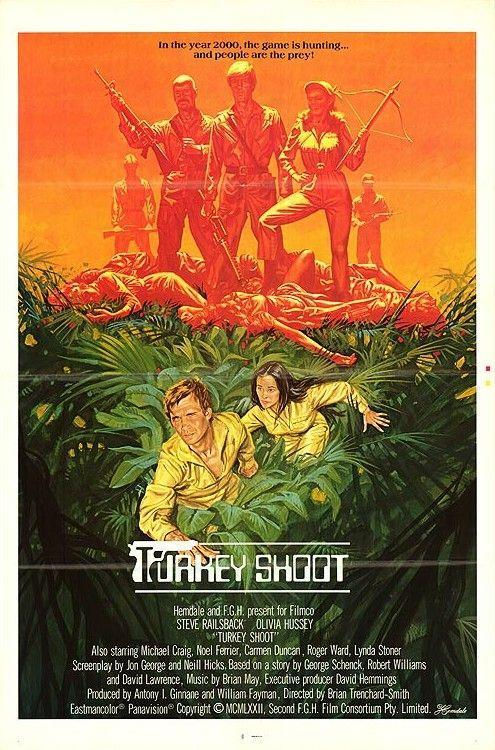 |
|---|


