


Dr Jekyll & Sister Hyde (1971)

"The sexual transformation of a man into a woman will actually take place before your very eyes!"

Plot
Dr Jekyll is a brilliant scientist who has spent his life trying to create an "antivirus" to cure some of the world's most deadly diseases. But he realises that his quest to preserve life will ultimately be ended by his own death at some point and decides to test out a serum on himself which he hopes will prolong his life. He needs female hormones to be able to create this serum and enlists the aid of grave robbers Burke and Hare to provide him with fresh corpses to harvest. This supply doesn't last long though as they are caught and he eventually turns to murdering prostitutes himself. The serum also has devastating side effects on him and he temporarily turns into a woman from time to time. Attempting to cover up the secret, he passes his alter ego off as widowed sister, Mrs Hyde. Realising where his work is taking him, Jekyll tries to stop the killing but Hyde is growing stronger inside him and beginning to take over his mind and body.
Review
Usually when we talk about Victorian literature or classic horror, we have a very specific vibe in mind. Foggy London streets, gas lamps flickering, maybe a horse drawn carriage clattering over cobblestones, shady people standing off in the shadows. And of course, the repressed gentleman scientist who drinks a bubbling potion and turns into a hairy, brutish monster - the classic Jekyll and Hyde setup. It’s comfort food for old school horror fans and you know exactly what is on the menu. But in Dr. Jekyll and Sister Hyde, that menu is being taken and shredded. Hammer’s 1971 take on that classic Robert Louis Stevenson story gives it a very specific, very bizarre and honestly a very 1970s twist which is ironically more relevant today in 2026's gender fluid-obsessed world than it was back then.

Twist is the right word for this one because a lot of people might have actually moved on by because the title sounds like a pun - Dr. Jekyll and Sister Hyde. And I want to be clear right off the bat, that title is literal. In this version, the good doctor doesn't turn into a hulking beast. He transforms into a beautiful, seductive, and absolutely homicidal woman. It sounds like something from a TV sketch show or perhaps a Carry On Screaming-style spoof. But make no joke about it – this is late-stage Hammer horror, so it's gothic, it's deadly serious, it’s bloody, and it is genuinely psychological. This isn’t just a cheap gender swap gimmick. It is an ambitious mashup of almost every major Victorian legend you can think of. You’re talking Jack the Ripper, grave robbers, the whole nine yards. Script writer Brian Clemens went to town on this one. At the heart of the film is a bizarre love square. Not a love triangle, a love square. I cannot wait to get to the geometry of that nightmare later on and it gets complicated.
But before we get to the romance, let's start with the science or in this case, the mad science. In the original novella, Jekyll is trying to separate good and evil. It's a philosophical experiment. What is driving this man? This version of Jekyll is much more pragmatic and significantly more arrogant. He’s a brilliant scientist, but he is not interested in the duality of man. He has a very specific, tangible goal. He wants to create a universal antivirus for everything. He believes he can cure every major disease known to man. Flu, cholera, typhoid, you name it. He wants to wipe out sickness entirely which, if he succeeded, would make him the ultimate hero. That is a Nobel Prize winning motivation. He wants to save the world. But then he runs into a logistical problem and hits a wall. He realizes that science is slow and life is short. A single human lifetime simply isn't enough to finish the research required to cure every disease. Vaguely reminiscent of the reasoning behind the robot monster in The Colossus of New York, the idea that brilliant minds burn brightly but too quickly ends up with Jekyll doing the maths and realising he's going to die of old age before he can save the world. So, the clock is ticking and thus the narrative pivots. He decides that before he can cure the world, he must cure death itself. He needs to create an elixir of life, a serum that will prolong his existence so he can finish his work. This is the classic startup-founder mentality gone totally wrong. He is optimizing for his own survival, but he tells himself it is for the greater good. But here is where the Victorian mashup really kicks into gear. Because the ingredients for this life-extending cocktail, you can't exactly order them on Amazon. Jekyll determines that the key to eternal life, or at least prolonged life, lies in female hormones. Dr. Jekyll and Sister Hyde operates on this pseudoscientific logic that because women tend to live longer than a man, their hormones hold the secret to longevity. But remember, this is 19th century London, you don't get hormones on tap. He needs fresh glands, which means he needs fresh bodies. And this is the first big connection the film makes to real history. If you are a doctor in Victorian fiction and you need fresh corpses, there's really only one firm you hire. You hire Burke and Hare, body snatchers.

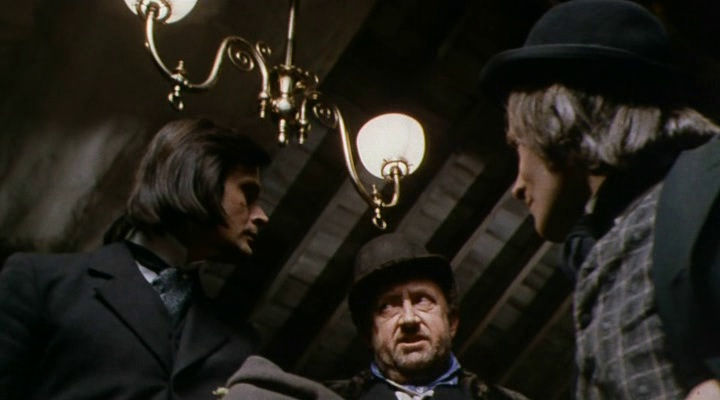
They’re the infamous grave robbers. I love that the film just drops them in. It grounds the story in this grimy historical reality and is extremely clever world building. You have these real-life historical villains working as supply chain managers for a fictional scientist. They are digging up fresh graves and delivering the raw materials to Jekyll's back door but this type of business has a shelf life. Historically, the pair didn’t get away with it forever. Eventually the law catches up with them, the mob gets angry, and the supply of fresh graves dries up. And this is the pivotal moment for Dr. Jekyll here, where he goes from unethical researcher to straight up monster and despite the fact he can't buy the bodies anymore, he doesn't just stop the experiment, he doesn't just give up. He decides to cut out the middleman. When the grave robbers are out of the picture, Jekyll takes to the streets. He starts murdering prostitutes himself to harvest what he needs. And this leads to the second and honestly kind of brilliant mashup element, offering up a narrative explanation for the Jack the Ripper murders. It connects the dots in a dark, fascinating way. In the universe of this film, there is no separate Jack the Ripper. The Ripper is Dr. Jekyll and the murders aren't random acts of violence or crimes of passion, they are a scientist harvesting raw materials for his life extension serum. So this brilliant script has taken three separate Victorian nightmares (The duality of Jekyll and Hyde, the bodysnatching of Burke and Hare, and the brutality of Jack the Ripper) and it says, what if this was all just one guy having a really, really bad month? A very violent month as it turns out and it creates an incredibly oppressive atmosphere. This is arguably the deadliest version of Victorian London you will ever see on film. It is drenched in fog, darkness, and eternal despair. They even throw in a reference to Sweeney Todd and his meat pies, just in case you weren't already nauseous. If you are going for gothic excess, you might as well invite the demon barber to the party.
So have the motivation - to live forever to save the world. We have the method - murdering women for hormones. Jekyll creates the serum and drinks it but because the primary ingredient is female hormones, the side effect isn't just that he gets younger. The hormones trigger a total biological metamorphosis. He doesn't just get a smooth complexion; he transforms into a woman. Enter Sister Hyde. This is where I need to address the elephant in the room here. For a modern audience or even an audience in the 70s, the immediate comparison is comedy. You think Mrs. Doubtfire, Tootsie, Some Like It Hot. It's the classic trope of the man in a dress designed to elicit laughs from the shenanigans he gets up to in it. Dr. Jekyll and Sister Hyde is visceral body horror so despite a few moments of very dark humour, the tone here has a disturbing sexual element which crosses a lot of boundaries. You are dealing with themes of homosexuality, transvestitism, and gender confusion, but it is not exploring them as a social commentary or an identity politics critique. It is using them to unsettle the audience. It is designed to make you feel uncomfortable. This is not a deep philosophical study on gender identity; it is a horror movie using gender fluidity as a source of tension. That tension explodes in the relationship dynamics and where we get to that love square I mentioned earlier. Jekyll lives in an apartment building. He has neighbours, a brother and sister named Howard and Susan. Jekyll needs a cover story for his new female alter ego. He can't just say, “oh, that's me on the weekends”. So, he introduces her as his actual widowed sister, Mrs. Hyde, who has come to visit. Howard, the male neighbour, falls in love with the beautiful, mysterious Mrs. Hyde who is physically a woman, but mentally has the consciousness of Dr. Jekyll. Meanwhile, you guessed it, Howard's sister Susan falls in love with the male Dr. Jekyll. So you have a brother and sister falling in love with two different versions of the exact same person. And because they live right next door, the proximity creates this pressure cooker. There is a moment where Mrs. Hyde is with Howard. It is a romantic scene. She is caressing his face. But midway through, the serum starts to wear off. She starts transforming back into the male Dr. Jekyll physically, while still being intimate with Howard. Mrs. Hyde is unaware it is happening at first. It creates this incredible dramatic irony where the audience is screaming, get out of there. It is the definition of awkward, but it is also deeply tragic. Howard and Susan don't know what we know and they're just innocent bystanders in this mad science experiment. They are the true victims here and their love is tragic and doomed to fail. They are falling for a phantom, two halves of a monster.
This brings up how we view the protagonist. In almost every version of the Strange Case of Dr Jekyll and Mr Hyde, from the cartoons to the serious dramas, we basically feel bad for Dr. Jekyll. He is usually portrayed as the good guy who just wants to repress his dark side but loses control and becomes a victim of his own curiosity. The original Mr Hyde represented unleashed, uncontrollable impulse and rage. This not the case here though as this Jekyll is arguably a worse person than his alter ego. He a nasty piece of work before he ever touches the bottle, equally cold and calculating. He’s the one who decides to hire grave robbers and murder women in the street. Hyde is just the tool he uses to get away with it. Or rather, Mrs. Hyde is the disguise. He adopts a brutal utilitarian logic., believing that sacrificing low lives, which is how he views the prostitutes, is a mathematically sound trade-off if it allows him to live longer and save millions. The quote “one death is a tragedy; a million is a statistic” is famously misattributed to Stalin but is the same logic used by men throughout human history to justify mass murder and genocide. The “I am doing this for the greater good. These lives don't matter as much as my grand vision” is a chilling thought to maintain. Therefore, when Jekyll starts losing control and when the Mrs. Hyde persona starts taking over his mind and body, we aren't rooting for him to find a cure. There is zero audience sympathy for Jekyll. He created this nightmare through his own arrogance. He is a villain in both bodies. When the walls start closing in, you are essentially watching a bad man get what he deserves. It is interesting because usually, in horror, the monster is the Other. It's a vampire, a werewolf, an alien. Here the monster is the ego, and the film uses that famous Hammer Horror style to really sell that monstrosity.
For audiences who didn't grow up with these movies or haven't seen them on late night TV, Hammer Horror is almost a genre unto itself. Hammer Film Productions was a British studio that defined horror from the late fifties into the seventies. When you hear Hammer, you should think vivid, Technicolour blood that looks almost like paint. You should think of gothic sets that look incredible but are clearly sets. And you think of period costumes and heaving bosoms. However, by 1971, when Dr. Jekyll and Sister Hyde came out, Hammer was struggling a bit. The horror landscape was changing. The American scene was getting grittier. Think Night of the Living Dead or The Texas Chain Saw Massacre just around the corner. Hammer felt they had to ramp things up to stay relevant and started turning up the dial. The lavish Gothic set design is still here, with the back streets of London glorious in their seediness. But the adult themes are much more explicit - lots of blood and a fair amount of nudity. Often in these films, that stuff feels gratuitous, like it's just there to sell tickets to teenage boys. But here, it serves the narrative because the story itself is inherently sexual and biological. The violence is functional. It is how Jekyll obtains the hormones and the nudity comes into play during the transformations. Let’s face it, if you transform from a man to a woman, your clothes aren't going to fit! Watching Jekyll come to terms of being a woman literally exploring his own new body in the mirror is fascinating. It adds to the body horror and the psychological disorientation, forcing viewers to confront the physical reality of the change.

This sense of body dysmorphia would only work if you had two incredible actors to pull that off you need two incredible actors. This is 1971, well before fancy special effects came into play and you can’t just use motion capture to showcase a transition between man and woman. You need to find a pair of actors who can convincingly play two halves of the same soul. Ralph Bates was being groomed to be the next big thing for Hammer, the heir apparent to legends like Peter Cushing and Christopher Lee, and was given a few platforms in the early 70s to try and cement that legacy with roles in The Horror of Frankenstein, Taste the Blood of Dracula and Fear in the Night. They were huge shoes to fill and while Bates never quite reached that level of global fame, this his best work. He plays Jekyll with a certain restraint. He is not chewing the scenery as he could have done. He is cold and detached, making him scarier. He anchors the film. And then on the other side of the mirror, we have Martine Beswick as Sister Hyde. The role was originally offered to Caroline Munro, who was a bigger star at the time, but she turned it down specifically because she refused to do the nudity required for the transformation scenes (this would have been the biggest box office hit ever if she had done it, believe me!) It is a tricky role for Beswick because she has to be a woman, but a woman who is secretly a man. Her performance oozes sexual aggression. She looks unpleasant in murder mode and is not playing a damsel; she is playing a predator. But the most crucial observation about Beswick and Bates is their faces. Usually in body swap movies, the actors look nothing alike and we must suspend disbelief, but the two leads share a very strong facial resemblance. They have similar bone structure, similar eyes, which helps sell the illusion that they are the same person. This is a bit harsh on Beswick’s part as the film works so hard to convince you she is a man in a woman's form, it becomes difficult for the viewer to find her attractive, even though she is objectively beautiful. You know she is actually a man who murders women and this messes with your head - you are looking at her, but you are seeing him. This is exactly what good horror should be: confusing and repulsive.
Final Verdict
In the midst of this gender bending, Ripper explaining, gothic body horror tragedy, we’ve got a solid Hammer film. It’s not the best one Hammer ever made but it’s certainly one of their strongest films from their later period when they were really struggling to find new material. It’s highly underrated and a must watch for fans of old school horror, but one I feel is often overlooked when it comes to the studio. It maybe not an Oscar winner, but a really effective atmospheric ride. Dr. Jekyll and Sister Hyde is a suspenseful graphic reimagining. It is not perfect and mashing up the different Victorian historical stories somewhat detracts from the main plot, but there’s no questioning how ambitious and unique it was and still is. There was nothing else quite like it.
Dr. Jekyll and Sister Hyde forces us to look at the classic story differently, stripping away the excuse that the potion made him do it. It suggests that the evil isn't an external force. It is not a demon you summon. It is just you. It is the things you are willing to do when you think no one is watching, or when you think you have a good enough excuse. Sometimes the most terrifying monsters aren’t the ones with claws or fangs, but the ones with a noble cause and a clipboard.
 |
Dr. Jekyll & Sister Hyde Director(s): Roy Ward Baker Writer(s): Robert Louis Stevenson (based upon the story by), Brian Clemens (screenplay) Actor(s): Ralph Bates, Martine Beswick, Gerald Sim, Lewis Fiander, Susan Brodrick, Dorothy Alison, Ivor Dean, Philip Madoc Duration: 97 mins |  |
|---|


