


House of Wax (1953)

"The ultimate dimension in TERROR!"

Plot
Talented sculptor Professor Henry Jarrod runs a waxworks museum but refuses to add more sensational exhibits to increase profits, infuriating his business partner Matthew Burke who wants to end their partnership. Sensing an opportunity to cash in on an insurance policy, Burke sets the museum on fire with Jarrod still inside and he is presumed dead. Sometime after acquiring the insurance money, Burke and his girlfriend are both murdered and their bodies disappear from the morgue. At the same time, Jarrod reappears, his hands and feet disfigured by the figure and confining him to a wheelchair. He opens a new waxwork museum, this time dedicated to the sensationalist exhibits he refused to display previously and where the wax dummies appear to be far more realistic than ever.
Review
Imagine you are a high-powered executive at Warner Brothers in the early 1950s. Your studio is suddenly just bleeding money and those cinema seats you used to fill so easily are just sitting completely empty. Why? Because this glowing, hypnotic little box called a television has just invaded millions of living rooms across the world. Now your customers are staying home and getting entertained for free, and your entire and your entire industry is just staring down the barrel of obsolescence. I mean that could refer to today’s age where studio executives are worried about dwindling attendances thanks to streaming but we’re talking about the first big threat to cinema. So, what do you do? You turn to a new gimmick, one which isn’t readily accessible at home and hope that will get the crowds flocking back. A remake of the 1933 film Mystery of the Wax Museum, House of Wax was the first colour 3D feature film from a major American studio in the short-lived 3D fad of the 50s. This single film revolutionised 3D technology and accidentally launched one of the greatest horror careers of all time. Indeed, many of the scenes seems to have created solely for the purpose of showing off the technology as best as they could with can-can dancers kicking their legs at the camera or a carnival barker pinging a paddle ball repeatedly at the camera. The 3D gimmick allowed House of Wax to become a massive box office hit for Warner Brothers when it was released, and it has since become a landmark film for its use of the technology. And its this reason why your viewing experience of the film will be so different as to whether you see it in its original format or the standardised 2D format.

In its original 3D form, House of Wax is a revelation of continuous gimmick moments designed to shock and stun 50s audiences in much the same way as Avatar did to audiences in the 2000s. In a decade where films like House on Haunted Hill and The Tingler (both starring Vincent Price as well) were using in-cinema gimmicks to attract audiences, the novelty of seeing things ‘come to life’ in 3D on the screen would have been fantastic. House of Wax was a massive cinematic milestone, utilising a brand-new system called Natural Vision 3D. It wasn’t just something you could do in post-production; they literally had to strap two massive, incredibly heavy film cameras together side by side. The lenses were offset by a few inches, specifically designed to mimic the exact distance between human eyes. When they shot a scene, they were exposing two separate strips of film simultaneously, one capturing the left eye view and one capturing the right eye view. Then when you sat in the cinema, the projection booth had to run two separate projectors perfectly synced together, beaming both images onto the screen at the exact same time. The audience would be wearing polarised glasses: the left lens of your glasses only let in the light from the left projector, and the right lens only let in the light from the right projector. Your brain took those two slightly different flat images and stitched them together, creating the illusion of physical depth. If one projector ran even a fraction of a second faster than the other, or if the film reel snapped and had to be spliced back together unevenly, the whole 3D effect would completely break down.
The irony to all of this is that the man Warner chose to direct this film, André De Toth, had lost an eye when he was young and had zero biological depth perception. He couldn't even put on the polarised glasses to check if the dual camera rig was working properly. Maybe this was for the best because Toth couldn’t just rely on cheap moments of things flying out at the camera lens (there are a few of them though!) and had to focus more on deep layered staging. Because de Toth couldn't see objects popping out, he orchestrated the production design to offer profound front to back depth, placing objects in the extreme foreground, mid-ground, and deep background. There is an early scene where Price simply walks behind a wax figure positioned very close to the camera. It sounds rudimentary now, but in 1953, capturing that spatial relationship with the dual camera setup created this incredibly immersive sense of physical space. The workshop sets were designed specifically for this layered depth, bubbling vats of hot wax in the back, test tubes in the middle, electric conductors framing the edges of the screen. Toth made the space itself feel alive and thus you get one of horror’s greatest sets – it’s almost a Frankenstein laboratory-like in its construction.
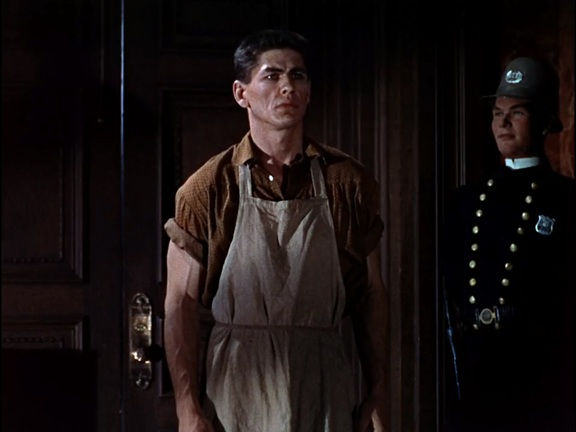
The lurid Technicolour delivers a Grand Guignol vibe to everything, rejoicing in the macabre on display. For context, the Grand Guignol was an infamous Parisian theatre that specialized in hyper-realistic, gruesome live horror. De Toth wanted that visceral stage play terror, so he utilized a heavy chiaroscuro lighting technique. Just stark, oppressive shadows contrasting sharply against bright, vivid Technicolor. There’s one specific chase scene where this all comes together perfectly. The heroine, Sue Allen, is being pursued by the cloaked, disfigured killer through the cobblestone streets and the set is shrouded in thick fog. If you were sitting in the cinema in 1953, the chiaroscuro lighting wouldn't just look pretty to you. The 3D cameras tricked your brain into feeling like the shadows were stretching out and wrapping around your seat. The darkness itself felt deep, physical, and endless. This is precisely what the studio hoped would pull audiences back in from the comfort of their home televisions as it was something that just couldn’t be replicated in your living room.

House of Wax revitalised the career of Vincent Price (who had been playing secondary characters since the 1930s and was rarely considered leading man material) and saw him become one of the names most synonymous with the horror genre, resulting in him portraying mad scientists, deranged characters or fiendish villains for almost the rest of his acting life. This is the first of his 'devilish villain' roles that he'd relish in years to come in such films as House on Haunted Hill, The Tingler, House of Usher, The Masque of the Red Death, The Abominable Dr Phibes, and Theatre of Blood. Jarrod is this kindly, deeply passionate artist who just refuses to compromise his craft for cheap thrills, so we feel genuinely bad for him and what happens to his art at the start of the film. He's horribly disfigured in the blaze, confined to a wheelchair, and his hands, the very tools of his genius, are completely destroyed. Price's delivery always has that velvety conviction that can turn lines of dialogue into exquisite poetry which make the audience really understand his devoted connection to his work.
It's when Jarrod turns into the disfigured Phantom of the Opera-style murderer that Price really begins to shine though, relishing the sinister turns of phrase and hidden meanings that the script adds to everything he says. He crosses the line from a sympathetic martyr into a man who just revels in his own darkness. The grizzly makeup he wore to depict Jarrod's burn scars was so viscerally repulsive that Warner Brothers banned him from the studio commissary and forced him to eat in isolation as he was putting the others in the cast off their food. I mean looking at the make-up today, it’s crude and primitive but I bet back then he was the most despicable thing audiences had ever seen.

House of Wax also sees one of the earliest on-screen roles by a then-little known actor by the name of Charles Buchinsky, who changed his name to the more famous Charles Bronson shortly afterwards as he thought his Slavic-sounding surname would attract unwanted attention during the anti-Communist McCarthyism era of the 50s. Bronson is cast as a mute so he doesn't speak but it's clear from this early age that he's got 'it' when it comes to screen presence. The film also has an early role for Carolyn Jones who also go on to greater fame as Morticia in The Addams Family TV series. For everyone else in the cast, they're overshadowed by the towering tour-de-force that is Price and his performance though.
Final Verdict
One of horror’s most influential films, House of Wax is still a classic old school trip down memory lane. All the money it cost to make is up there on the screen in fantastic Technicolour and with a star turn from Vincent Price, it’s always going to hold a special place in the pantheons of the genre. The runaway financial success of the film altered the trajectory of the genre by proving that horror didn’t have to be relegated to cheap black and white B movies anymore. It established a lush, gothic horror aesthetic in American cinema, almost certainly paving the way for the legendary Hammer Horror films in the UK and the incredibly atmospheric works of Italian directors like Mario Bava in the decades that followed. House of Wax proved that horror releases could be big, prestigious events. Warner Brothers even tried to capitalise on it again in the 1960s by attempting to make a House of Wax television series using the film’s leftover sets but it was ultimately deemed too intense for standard television and got repackaged as a theatrical movie called Chamber of Horrors. Beyond the gimmicks, the terror of House of Wax still resonates perfectly today.
 |
House of Wax Director(s): André De Toth Writer(s): Crane Wilbur (screenplay), Charles Belden (story) Actor(s): Vincent Price, Frank Lovejoy, Phyllis Kirk, Carolyn Jones, Paul Picerni, Roy Roberts, Angela Clarke, Paul Cavanagh Duration: 88 mins | 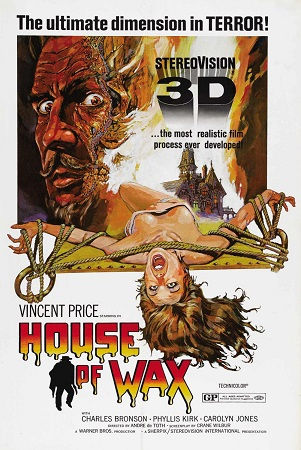 |
|---|


