


House on Haunted Hill (1959)

"The doors are locked at midnight."

Plot
Millionaire Frederick Loren invites five random people for a party with him and his wife inside an apparently haunted house. Anyone who stays inside the house will earn $10,000 dollars the next morning. But as the night draws on, everyone inside realises that this will be no ordinary party.
Review
Most of us have been inside a haunted house – I don’t mean an ‘allegedly haunted’ real house but one of those cheap fairground or theme park attractions where skeletons pop out of coffins, cobwebs hang from the ceiling, and smoke machines go into overdrive. It’s one of the earliest experiences of horror that we’ve all had, usually as children as they’re normally tame and harmless enough not to cause any lasting damage. House on Haunted Hill is the cinematic equivalent of this fluffy fairground experience, a harmless and scare-free horror flick that probably didn’t get pulses racing back in the 50s and 60s, let alone the 2020s. The film deliberately leans into this aesthetic; one of the earliest horror experiences many of us will have had at a theme park ride or carnival ghost train.

Director William Castle was known for his gimmicky horror films back in the 50s where everything he made had to be a cinematic event to draw in the punters, just like the barkers standing in front of the fairground asking people if they dare to enter. House on Haunted Hill came complete with a flying skeleton in some cinemas which would pop out and float over the audience on a wire pulley system at the appropriate moment in the film. Castle understood that the imagery on the screen was mostly just harmless fun. So, by introducing a physical object into the real space of the audience, he crossed that boundary between the film and reality and tried to break down the fourth wall. The late 1950s was the height of the Cold War and the Atomic Age. Children were literally doing duck and cover drills under their desks at school. The real world was suffused with genuine existential dread. Audiences weren't necessarily looking for films to traumatise them further as they had enough real-world terror. Audiences wanted a release valve. A glowing plastic skeleton on a wire provided manageable anxiety. It was a monster they could point at, laugh at, and ultimately defeat. Castle’s gimmicks brought people into the theatre because they offered a communal safe catharsis, but you’ve also got to remember that audiences back then weren’t just totally naïve. A plastic skeleton on a wire Is a great marketing hook, but it isn't enough to sustain a ninety-minute feature film on its own. If House on Haunted Hill was essentially a harmless scare-free horror flick, there had to be something else driving its success. A pulley system couldn't possibly carry the entire weight of the film’s legacy, especially since that gimmick couldn't be packaged and sold to television audiences later. Like with his other gimmick films such as The Tingler, I’m sure this would have caused a few pulses to race in the cinema if you didn’t know what to expect, but this type of interactive gimmick was a once-in-a-lifetime cinema experience that can’t be replicated anymore, especially not when you’re watching it from the comfort of your living room. You had to be there to experience it.
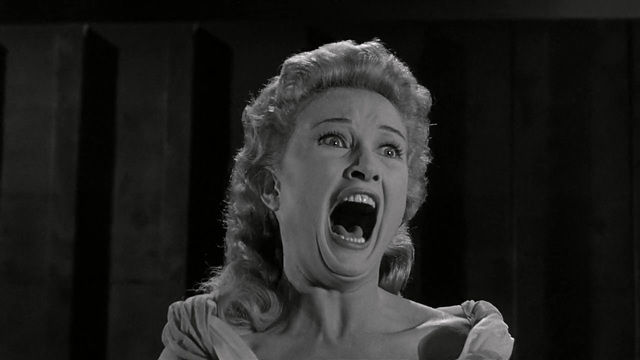
The skeleton is about the only real trick in House on Haunted Hill’s book. Despite its fame, it’s not scary in the slightest, with only a few moments even raising a hair on the back of your neck. What it is though, is a lot of daft fun. You expect some cheesy ‘boo’ moments and some very dated effects to scare its then-contemporary audience and the delight is watching it all unfold before your eyes. The sound effects used throughout are like one of those special albums you get around Halloween time to add some spookiness to your own party or home haunt, with rattling chains, howling wind, creaking doors, etc. The key to House on Haunted Hill is that the monsters aren't supernatural entities at all. The ghosts are almost a smokescreen, like a convenient cover story that the characters of Frederick and Annabelle Loren use to mask their own lethal games which creates such a beautiful contrast. You have the daft, fluffy haunted house tropes operating on the surface, while a genuine, sophisticated film noir plot simmers right underneath it. The haunted house is merely a stage setting for their marriage, which is so incredibly toxic it completely overshadows any ghost story. The script, which was written by Robb White, performs this masterful subversion of expectations. You sit down expecting a supernatural thriller, but White turns it into a razor-sharp, murderous marital thriller wrapped in a Gothic aesthetic. Frederick and Annabelle absolutely loathe each other. Their relationship is a high-stakes game of domestic cat and mouse. Frederick makes open death threats against Annabelle in front of the guests. But to successfully pull off a very smart script that balances those two completely different tones, the cheesy Halloween gimmicks on one hand and the razor-sharp marital chess match on the other, it requires a very specific type of actor. They must play the melodrama of the haunted house while keeping the genuine threat of the marriage grounded and sharp: if they lean too far into the camp, the tension just evaporates, but if they play it too seriously, the fairground aesthetic feels totally out of place.

House on Haunted Hill works for two reasons: the smart script as mentioned and one of the best performances in his career in the shape of Vincent Price. I’ll start with Price, as this became one of his signature films, and it was the film that cemented his place in horror folklore, leading him to become one of the most famous names associated with the genre. His character, Frederick, became the archetype Price antihero – mild-mannered, well-educated, impeccably dressed and completely lethal. As film viewers, we are evolutionarily wired to recognize threats through clear markers of aggression: shouting, erratic movements, bared teeth, etc. But Price bypasses all our natural defence mechanisms by using the manners of a high society gentleman. He essentially short-circuits the audience's threat detection system. He offers you a drink, casually discussing murder with perfect diction and a raised eyebrow. You will find yourself captivated by him, perhaps even secretly rooting for him despite his terrible actions, because his intellect and his charm are just so intoxicating. He treats the entire evening like an amusing parlour game and he’s just having fun with it. It's a delicious performance, one which Geoffrey Rush did a fantastic job of impersonating when he took on the reigns in the 1999 remake.

But to make that dynamic work, an antihero of that calibre requires a worthy adversary. He cannot be plotting against a helpless victim, or the charm turns into mere cruelty. Not to be outshone, Carol Ohmart is brilliant as Annabelle, Loren’s bitter fifth wife, and the perfect counterweight. She knows things are afoot thanks to Loren’s open death threats towards her (and the knowledge he’s already had four previous wives would surely send some alarm bells ringing!) and tries to match her wits against his, turning herself into an apex predator determined to finish off its chosen prey. The exchanges between the two are smart, sharp and dangerous, creating a nice feeling of tension to the film as the two are more concerned with surviving the night from each other’s murderous advances than they are any real ghosts. When the two share the screen, and numerous barbs, the dialogue feels less like a conversation and more like a fencing match. They speak in this incredibly venomous shorthand where every single pleasantry is lighted with a hidden threat, and you become invested in the psychological warfare of this marriage – completely forgetting all of the daft skeletons and cobwebs from earlier.
Final Verdict
For its greatest effect, House on Haunted Hill needed to be seen back in its cinema heyday, in an era where horror was still innocent and sweet. It is a charming product of a time where cinematic horror was paradoxically quite innocent compared to the gritty, inescapable horror trends that emerged in the 1970s and beyond. But the great script and fantastic turns from the two leads turns what could've been a forgotten silly B-movie into a timeless piece of smart cinema. The actors clearly understand the assignment too. I mean, they look like they are having the time of their lives delivering these incredibly dark, witty lines amidst all the theatrical camp. Anyway, who knows in the next couple of decades and with the advent of augmented reality, we may even start seeing skeletons floating out of television screens at home and dancing around the living room, bring Castle’s carnival vision to life for a new generation to experience like never before.
 |
House on Haunted Hill Director(s): William Castle Writer(s): Robb White Actor(s): Vincent Price, Carol Ohmart, Richard Long, Alan Marshal, Carolyn Craig, Elisha Cook Jr., Julie Mitchum, Leona Anderson Duration: 75 mins |  |
|---|


