


Night of the Big Heat (1967)

Updated: Feb 26
"Searing terror! Burning in its intensity!"
Plot
Whilst the rest of Britain freezes in deepest winter, the northern island of Fara bakes in usually hot weather. The crew at the Met station have no idea what is causing this heat but when people start to hear strange noises and are found scorched to death, the locals begin to suspect something deadly is at hand. A scientist on the island studying this phenomenon believes that the island is being used a beachhead for an invasion by aliens who need high temperatures to survive.
Review
Picture this: it is the absolute dead of winter in Britain. We’re talking freezing temperatures, frost everywhere. Everyone is bundled up in their thickest coats. But on this one remote island, Fara, something impossible is happening. It's sweltering. It's baking hot. The temperature's climbing, the locals are panicking, and there is absolutely zero explanation for it. It's such a great, simple hook that immediately contradicts itself: the geography is telling you "freeze!" but the plot is screaming "burn!" It creates this immediate sense of wrongness. And that’s exactly where you’ll be going for the 1967 sci-fi horror film, Night of the Big Heat. It is a curiosity, one with so much perspiration, and with a title that sounds like a 1930s film noir detective mystery. There are the titans of horror dream team, Peter Cushing and Christopher Lee, on screen together. There’s a legendary director trying to reinvent himself. And there's a production story that's way more unpleasant than the actual aliens in the movie.

Night of the Big Heat sets us up with the classic isolated community in peril setup. There are strange buzzing noises, locals are getting suspicious, and then things begin to escalate. It goes from uncomfortably hot to lethal, where people are found scorched to death. It’s a nasty physical element to bring into what starts as a winter mystery, but to really get why this film looks and feels the way it does, it’s important to talk about the director, Terrence Fisher. Basically, the architect of British horror, he didn't just work for Hammer Film Productions, he defined their entire style in the late 50s – the fog, the castles, the Technicolour blood, etc. He took horror out of the old school Universal black and white and made it vibrant. However by the mid-sixties, Hammer’s Gothic style was starting to feel a little old fashioned, especially in the atomic age. People were worried about radiation and things from outer space, not vampires or werewolves. Fisher left Hammer and went to another studio to make a trilogy of science fiction films (The Earth Dies Screaming, Island of Terror, and Night of the Big Heat), where the results were fascinatingly mixed. The Earth Dies Screaming was etched into my mind as a kid with some of its visuals and Island of Terror remains one of my favourite genre pieces.
But there’s this weird ironic thread connecting them, especially the latter two, because they’re genuinely strong, tense thrillers right up until the moment their monsters are shown on screen for the first time. It’s the classic monster movie dilemma: the imagination is infinite, but the budget for the rubber suit is not. Fisher was a master of atmosphere and tension - he could make a shadow terrifying. But he wasn't a special effects guy and when you must show a glowing alien blob in broad daylight, that gothic toolkit just falls apart. But more on that later because for the first two thirds of Night of the Big Heat, you’re watching people literally dying of heat stroke and drenched in sweat, In reality, it was filmed in the dead of winter. It’s a logistical nightmare, trying to sell unbearable heat whilst the actors can see their own breath. Wearing damp shirts is a standard issue trick but here, they smothered the actors’ faces in glycerine. Why not just spray them with water you may ask? It’s a physics thing as well as continuity. If you spray an actor with water, it evaporates, especially under hot studio lights, or just runs down their faces. So, one take they’re wet, the next they’re dry and the editor can’t match up shots. Glycerine is an oil, its viscous, which means it just sits on the skin and catches the light, giving the actors a more ‘natural’ overheating sheen. Just imagine how this must feel as an actor. You're outside, it's freezing, and someone has just smeared cold, sticky oil all over your face. It sounds like actual torture. The fact that the cast look so hot on screen is a real testament to the actors because they must have been miserable, but it works. When you watch the film, you feel gross. You literally sweat just watching them. Well, most of them sell this idea of blistering heat in the middle of winter. There is one huge, hilarious exception to this realism and it involves Peter Cushing.

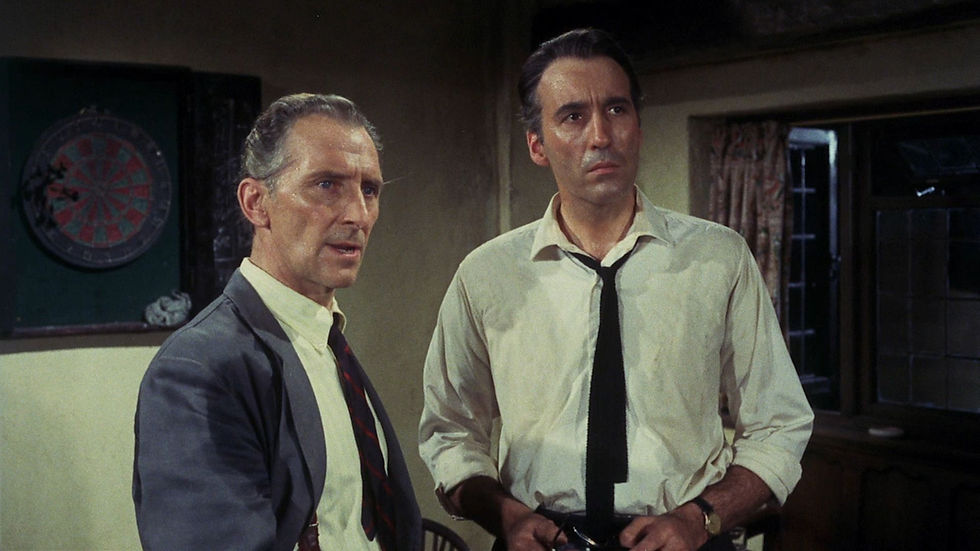
Everyone else is damp, shirts unbuttoned, chests exposed, hair plastered to their heads with glycerine. And then there's Peter Cushing. Despite the supposedly deadly heat, Cushing keeps his full suit on the entire time. He doesn't even take the jacket off. Three-piece suit, tight against the collar, and he barely seems to sweat. It's almost supernatural. He projects this clinical detachment to everyone else - if he took off the jacket, he's just another victim, but with it on, he's a scientific superhero ready to save the day. He anchors the film and sells the plot. Even if it makes zero sense for the weather, it makes character sense. He's the intellectual fortress the heat can't touch. It is a funny visual, though. You've got this damp shirt reality for everyone else and then pristine tweed-clad Cushing. Having remembered his turn as Winston Smith in the BBC adaptation of Nineteen Eighty-Four, Cushing can't half do crazy/maniacal well and all of this heat allows him to showcase his range.
Fisher uses that classic trapped on an island trope to really bring out of the best of all his characters. It’s the perfect pressure cooker. Whilst the visuals may not be up to the same standards as his Gothic past, Fisher knows that your eyes can’t play tricks with things you can hear and so he tightens the screws with audio. There's this high-pitched buzzing noise all through the film – the sound of the unseen menace. For a huge chunk of Night of the Big Heat, that sound is the aliens. It's this high-pitched, sort of mechanical, but also organic sound. It keeps you on edge. It's the Jaws effect before Jaws. Keep the shark hidden and let the audience's brain do the heavy lifting. But then you get to the kill method and this is where the logic starts to wobble. The aliens kill people with bright lights. The victims are found scorched, but the weapon is just an intense beam of light, which is a bit laughable. It feels like a budget constraint whereby they couldn’t afford a death ray, but they did have a spotlight. It's definitely 1960s sci-fi shorthand. Light equals energy equals death. But again, this is where the cast saves it. And you've got the duo, Cushing and Lee, to convey just what humanity is up against.

Usually, they're neck and neck as far as performances go, but here there's a bit of a divide. Let's start with Cushing. Cushing is, as always, just the consummate professional. He is head and shoulders above the material. He’s the type of actor who could read a grocery list and make it sound like an ancient spell, giving anything he performed in that believability factor. Night of the Big Heat’s script is full of just nonsensical science and gibberish explanations for the heat that wouldn’t stand up to much scrutiny. But when Peter Cushing delivers those lines with such conviction, you buy it and believe every word. He's the guy you want in a crisis. Christopher Lee, on the other hand, is usually the terrifying villain but here he plays scientist Godfrey Hansen, but the character is written as a complete and utter jerk. He's technically the film’s protagonist. We’re supposed to want him to succeed, but he's so arrogant and abrasive, it's just hard to root for him. It's a mix of both Lee’s acting style and the writing, fuelled by chaos on set. Lee talked about this in the DVD commentary and said that the script was being rewritten constantly. Imagine memorizing lines and then getting a new page that contradicts what you just read. Lee said the changes were often worse than the original script, so sometimes the actors would just ignore them. That frustration bleeds into the performance – Lee’s Hanson feels disjointed because the character on the page was a mess.
Patrick Allen is the secret weapon. You might not know the face, but you know the voice. He has this booming baritone - one of those recognizable voices from British TV and film who did a ton of narration and voiceover work (usually for film trailers and home video releases). Allen played a similar character in The Body Stealers – misogynistic and wholly unlikeable as a protagonist – and given that he was no oil painting as far as looks goes, I honestly can’t see why producers gave him this type of romantic lead role. Throwing him and his obnoxiousness into the mix with already hot-under-the-collar characters and there’s meant to be more tension on the human side. To pad out the runtime, the script forces in this really unconvincing love triangle. The film is barely long enough as it is, and this romance drama adds nothing, becoming a distraction from the survival story. So, you combine a boring affair with laughable monsters and that third act really struggles.

This is where the monsters appear and where the tragedy of the film really kicks in. We've spent an hour dreading these things. The tension is perfect, the noises they make and little glimpses of the damage they can do have amped up the fear dramatically and then they roll onto the screen. Well, more like shuffle. These blob-like creations, presumably leftovers from Island of Terror, are clearly just immobile rubbery props that sit there and glow. It is so bad that on the DVD commentary, you can hear the filmmakers and historians laughing when the aliens appear. It’s heartbreaking when the creators are laughing at their own monster, the horror is officially dead, and the film descends into farce. It's such a common downfall for this era. The ambition just outpaced the technology.
However, despite the rubber monsters, something very rare and very dark happens at the end of the film and spoiler alert if you’re not wanting to find out – you should skip to the final verdict right now. See, in almost every film they did together, either Cushing survives as the hero or Lee dies as the villain. But here, neither Christopher Lee nor Peter Cushing makes it to the end alive. Both die, and not heroically either, they're just wiped out by the heat and the aliens. It is a total casualty list for the leads and a shockingly bleak move for a cheesy B-movie. It gives Night of the Big Heat this nihilism you just don't expect and reinforces the whole invasion idea in a really serious way. The scientist's theory is that the island was a beachhead. The aliens needed those high temperatures to survive. They were just killing people. They were terraforming. They were cooking the island to make it comfortable for themselves. And the fact that our heroes, the smartest guys in the room, both die, adds this layer of hopelessness to the narrative. It suggests that maybe human intellect isn't enough to save us in the face of intergalactic annihilation. That's a very British sci-fi thing - the Quatermass-style feeling of we are small and the universe is hostile. It saves the movie from being a total joke, with the ending having some grim weight to it. end spoiler alert.
Final Verdict
Night of the Big Heat is a film of fascinating contradictions, a winter shoot that's a summer heat wave, a gothic director doing sci-fi, and a brilliant auditory build-up with a disastrous visual payoff. It really is a lesson in the power of the unknown. The buzzing sound: terrifying. The actual monster: hilarious. The problem is that see this all the time in horror. The film is scary when the menace is a shadow, a sound, a suggestion. The moment it's revealed, the fear just evaporates. Our own imagination is the best special effects department in the world. We conjure up the thing that scares us personally – a rubber suit can only be one thing, but a shadow can be anything. Once we see it, we can categorize it. We say it has claws and therefore you immediately understand it's physics. Once we understand it, we don't fear it as much, leading to the great paradox of the genre. Directors must show the monster eventually, but the film is almost always better before they do.
Night of the Big Heat is a film for the devotees. If you're a fan of this stuff, or a Cushing and Lee completionist, you'll have a good time. There's a certain familiar charm to it. But for a casual viewer just looking for a scary movie, there are better options. It doesn't rank anywhere near the best work of Fisher, Lee or Cushing. It's more of a curiosity, a B side track, not a greatest hit.
 |
Night of the Big Heat Also Known As: Island of the Burning Damned Director(s): Terence Fisher Writer(s): Ronald Liles (screen play by), John Lymington (based on a novel by), Pip Baker (additional scenes & dialogue by), Jane Baker (additional scenes & dialogue by) Actor(s): Christopher Lee, Patrick Allen, Peter Cushing, Jane Merrow, Sarah Lawson, William Lucas, Kenneth Cope Duration: 94 mins |  |
|---|


