


Psycho IV: The Beginning (1990)

"You've met Norman. Now meet Mother."
Plot
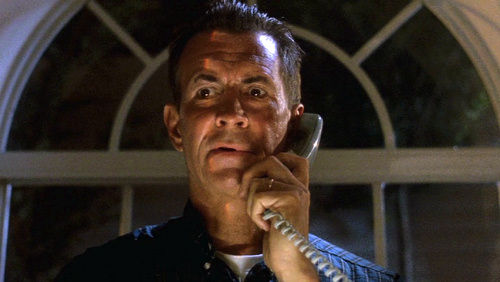
During a late night phone-in, Norman Bates shares memories of his childhood with a radio talk show host. During the conversation, he reveals that he is planning to kill his wife who is with child after abstaining from birth control. Norman doesn't want any children for fear that they will turn out the same way as he did.
Review
A far, far cry from Alfred Hitchcock's legendary original and even the solid first sequel, Psycho IV: The Beginning ends up as a lowly TV movie which acts as both a prequel and a conclusion to the series. I'm sure Hitchcock would turn in his grave if he saw how far the series had fallen - or maybe he'd be impressed that his original film was still considered sequel-worthy thirty years later. After two extremely belated cinematic sequels in the 80s (which clearly attempted to cash on the slasher boom even if they weren’t outright slasher films), this third sequel was sent straight-to-TV which is never a good sign. It's a pity because Psycho IV: The Beginning is not that bad and sets its sights out a lot higher than it should do. But like most prequels, it’s a case of whether we really need to know everything about Norman and does it dilute the character we came to know and, let’s face it, love?

Unfortunately, Psycho IV: The Beginning sets itself up with an improbable story - how on Earth is Norman a free man after the murders he has committed in the previous films? The film asks us to accept that Norman Bates, a character synonymous with madness, motel murders, and wearing his mother's clothes is essentially cured. He is out of the institution and trying to live a completely normal, mundane, suburban life. Think about how jarring that is. It's like a retired, world-destroying supervillain trying to casually mow the lawn in your neighbourhood. It feels inherently unnatural, and you just know deep down in your bones that it is bound to go horribly, spectacularly wrong. I mean, how hard is it to close the book on a horror icon? The filmmakers absolutely knew they were starting on thin ice here, and they made some highly unconventional narrative choices right out of the gate to set up this present-day reality. He's got a wife, an unborn child and looks to have a decent, uncontrolled life. The story makes it seems like this is the norm for any former mental patients - not to mention the fact he married his former psychologist which I'm sure breaches codes of conduct for the professionals. These scenes with the older Bates feel a little more routine and run-of-the-mill and are simply there to act as a wraparound story for the beginning and end of the film. The film clearly runs out of ideas in the final third too and just has Norman snap and go crazy again, stalking his wife through the Bates Motel. It's a pity it resorts to this as I'm sure there were other suitable things that could have been done to give the character some finality.

Rather than continue to dole out the same formula as the previous few films (is Norman killing people, or isn't he?), this one opts to turn more psychological and tries to explore some of the themes that the original Psycho suggested. Original Psycho screenwriter Joseph Stefano had returned to pen this script because Universal were desperately trying to course-correct the entire franchise. Psycho II and Psycho III had essentially stripped Norman Bates of his psychological nuance and treated him like he was Jason Voorhees or Michael Myers in order to cash in on the 80s slasher boom, something which Stephano disagreed with and, having been close friends with Hitchcock, would have been most likely what the legendary director would have thought too. The radio show framing device with Norman calling in under the alias Ed (a nod to serial killer Ed Gein, the original inspiration for the Psycho novel) allows for an exploration of his mental state rather than just his body count. It grounds the whole thing in conversation. And the radio host he's talking to is Fran Ambrose, played by CCH Pounder, who brings this incredible grounded gravity to the role. Pounder is one of those instantly recognisable actresses who really does a stellar job of everything she stars in.
Of course, director Mick Garris is no Hitchcock but at least the film tries to turn itself into something a little more than the TV movie sequel it is. The best parts of the film are those which involved flashbacks to Norman's childhood and his domineering mother. This is where the film makes its biggest gamble. It uses the radio call to pivot into extensive flashbacks, finally pulling back the curtain on the events that forged the monster. With disturbing and blatantly implied tones of incest, the scenes between the two characters are a fascinating explanation into the psyche of Norman. Whilst I'm usually against prequels feeling the need to explain everything and anything about the original, at least the material we're presented here makes sense because there's little shock revelation. We knew that Norman had a pretty screwed upbringing from the first film and this simply expands on everything we thought was true.

The strength of the film lies in its cast and Psycho IV: The Beginning is well acted across the board, in particular the three leads. At least all of the original Psycho films featured Anthony Perkins in the lead role to keep continuity (talk about being typecast though, does anyone remember Perkins doing anything else?). Perkins always managed to nail the role to a tee and was the sole constant throughout the series. Like slipping on an old pair of shoes, Perkins effortlessly assumes the mantle of one of cinema's most notorious characters. Henry Thomas plays the young version of Norman in the flashbacks and he's equally as impressive in an almost seamless transition between present and past. He manages to mimic and nail Perkins' traits down, right down to the nervous energy he brings, so you never question whether this is the same character.
Olivia Hussey co-stars in the role of Norman's mother, Norma, and her presence is a bit of a shock to the system because she’s young and good-looking. This isn’t the crazy old woman we’d expected to see but someone in the prime of her life with a young son. One moment she's caring and sweet, the next a cruel sadist who liked to punish Norman. After three films of build-up and hints at what Norman had to suffer as a boy, his mother is finally revealed and she's a nasty piece of work, torturing and manipulating him and really driving him over the edge at a young age. She demands total intimacy and absolute devotion from him, acting as his entire world, but she violently punishes him the moment he exhibits normal human development or desires outside of her control. There is definitely an element of a magician explaining his trick to an audience with these scenes, and the eventual reveal is somewhat gross and exploitative. Despite the lack of restraint in the script, Hussey's fully unhinged commitment to the role of Norma makes these scenes the most magnetic part of the film. She provides a fascinating, albeit a deeply uncomfortable, explanation of Norman's fractured psyche. By watching her, we finally understand the sheer emotional violence that created his madness. The subtlety is completely gone, but it is replaced by a raw, almost theatrical exploration of abuse. It changes the genre from a mystery to a tragedy.

Psycho IV: The Beginning is sadly let down by its final third because the script has nowhere else to go once it’s explored these themes and does revert to type, with Norman deciding he has to end the Bates bloodline once and for all. It becomes slow, it gets painfully drawn out, and it ultimately abandons the psychological chess match and resorts to a very generic slasher climax where Norman completely snaps, grabs a weapon, and stalks his wife through the old Bates house and motel. It is like they built this intricate, brilliant psychological escape room for the first two acts, exploring all this complex trauma, but they couldn't figure out the final puzzle, so they just broke the door down with an axe. The film abandons the very psychological nuance it was striving for, only to fall back on the lazy genre tropes it was supposedly trying to course correct away from. There are about four kills in the film too, no doubt mandated by the studio to ensure some attraction to the younger horror crowd.
Final Verdict
Psycho IV: The Beginning gets unfairly criticised in most quarters and compared to the original, yes it's justified. But it's not a bad sequel, doesn't really tarnish the reputation of Hitchcock's original and is certainly much better than its given credit for. Most importantly, Psycho IV: The Beginning gives Norman Bates a true valediction. They bring him all the way back to the original house in the motel for one final definitive send-off closing the loop on his story. And what makes this attempt a finality infinitely more poignant is the real-world context regarding Anthony Perkins. The actor, who had inhabited this role, shaped it and essentially carried this entire franchise on his back for thirty years, died from complications related to HIV just two years after filming this movie. He was battling illness during production. This truly was his farewell to the character that defined his life and it adds such a heavy layer of melancholy to the whole project. Knowing it was his final performance as Norman, and that he likely knew his time was short, really changes how you view that generic climax. It becomes less about the mechanics of a slasher plot and more about watching a cinematic legend say a prolonged goodbye to his most famous demon.
 |
Psycho IV: The Beginning Director(s): Mick Garris Writer(s): Joseph Stefano, Robert Bloch (based on characters created by) Actor(s): Anthony Perkins, CCH Pounder, Henry Thomas, Olivia Hussey, Warren Frost, Donna Mitchell, Tom Schuster, Sharen Camille Duration: 96 mins |  |
|---|


