


The Gorgon (1964)

"A Monster With the Power to Turn Living Screaming Flesh Into Stone!"

Plot
Professor Jules Heitz travels to the remote Eastern European village of Vandorf when one of his sons was accused of murder before taking his own life. However, he encounters hostility from the locals and suspects that they are hiding something from him. During the dead of night, the calls of a siren lure him to the ruins of the castle where he has a fatal encounter with Megaera, a snake-haired gorgon from Greek mythology who could turn a man to stone with her gaze. In his last hours, he manages to send a letter to his surviving son, Paul, who promptly arrives in Vandorf to be greeted by the same hostility and violence as his father. Paul also has an encounter with Megaera, although he is lucky enough to escape. Realising he needs help to combat this creature, he sends for his mentor and together the two men seek to break through the wall of silence from the villagers and expose the gorgon once and for all.
Review
Hammer had started to run out of ideas after their initial boom of bringing the old Universal classics into glorious Technicolour. Once they'd worked their magic on Frankenstein, Dracula and the Mummy, they had to come up with new fiends for their actors to battle. The problem with industrializing a genre is that the factory line eventually runs out of raw materials. There are only so many classic Universal monsters you can reboot before the audience starts getting restless. Hammer needed new fiends and they needed fresh intellectual property that wasn't tied up in modern copyright. Numerous cinematic offerings such as The Reptile and The Plague of the Zombies sprung up in the years following and here, we have one of their first attempts to try the Hammer magic onto something other than a Universal reworking. Instead of looking to Victorian literature, the producers bypassed the 19th century entirely and went straight back to ancient Greek mythology. They took the story of Medusa, the snake-haired woman who turns people to stone and dropped her directly into a moody Eastern European Gothic setting. The Gorgon bares all the hallmarks of the Hammer series but there's something missing here which is evident from the get-go.

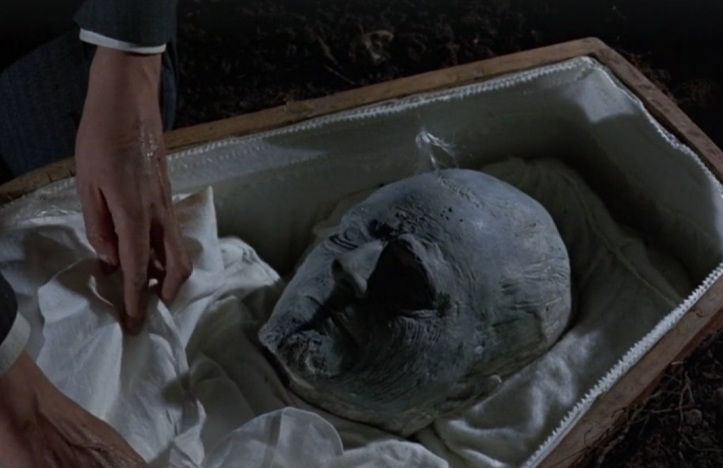
The first half of The Gorgon works the best simply because there's not as many characters running around, the story has a set direction, and it's drenched in atmosphere for the first few scenes around the ruins of the castle. Like many a Hammer film, there's an otherworldly presence lurking around in the night scenes. You're half-expecting the gorgon to pop out at any time whilst her victims stumble aimlessly around the castle. Of course being a low budget film, you're not going to see this creature until the very end. Thankfully the film plays upon this and the odd glimpse you do get of the gorgon is via silhouette or even a reflection in a fountain. It even messes with the gorgon mythology too so the victims don't immediately turn to stone. A slow and painful process of petrification sounds nasty and looks like it as a few of the characters here don't die straight away: they are fully conscious, as their skin hardens, their internal organs calcify, and their nervous system slowly shuts down, adding a bit of drama to their final moments. It's when the film slowly starts to unravel where the problems begin.

From this moody atmospheric period piece with the ruins, the siren song, the shadows, the body horror of petrification, The Gorgon then turns into a bloated, dialogue-heavy drawing room murder mystery, with the main characters trying to work out who Megaera is. Well stupidly enough, only one female character is actually given any screen time so it won't take a rocket scientist to work out who it is from the start. You'll find yourself screaming at the TV the name of the character in the hope that someone hears! It’s essential have some misdirection or red herrings in a film such as this to keep audiences engaged. You can’t introduce a single woman into the narrative and then expect the audience to gasp in surprise when they eventually reveal that she might be the ancient female monster terrorizing the town. The audience is forced to sit there and watch these supposedly brilliant, highly educated characters stumble through scene after scene of tedious procedural dialogue trying to piece together clues that are agonisingly obvious. It’s such a shame to see the film sink after such a promising opening but at least it provides a tragic sense of inevitability for the character.

Despite this turgid middle section, the finale is a perfectly tense and poignant scene where the gorgon is confronted in the castle once and for all. Like many Hammer films, it’s over far too quickly but there’s enough investment into the characters for it to pay off. In her early appearances, Megaera is given an almost fairytale-like appearance by director Terence Fisher, keeping her at arm’s length and in the background where needed. But producers always insisted on showing the monster front and centre to keep audiences happy and we get far too much of her in the finale, allowing audiences to see the shortcomings in Roy Ashton’s special effects: a dancer wearing green face paint and a bunch of mechanical snakes badly creaking around in her hair. It does kill off the illusion within literally minutes left in the film.
Christopher Lee and Peter Cushing star together here and it's refreshing to see them subverting their usual roles. Cushing gets to play the villain - well not so much a villain but a misguided lover) who is trying to protect the gorgon's human alter ego. His emotional attachment essentially makes him the villain, or at least the primary obstacle enabling the horror. Lee, on the other hand, steps into the role of the academic mentor coming to solve the crisis. He gets to be the hero for a change and it’s funny to see him as the older mentor to a ‘younger’ Cushing for a change. But his character is brash, obnoxious and arrogant: he is there to save the day, but he is going to condescend everyone in the room while he does it. It's not their best work together but you're never going to get sloppy phone-in performances from either of them. Even when there are handed scenes full of clunky exposition, neither of them dials it in. They treat the material with absolute Shakespearean gravity. They are consummate professionals who understand that their job is to sell the reality of the scene, no matter how flimsy the dialogue might be. There's good support from a variety of other character actors including Patrick Troughton and Barbara Shelley. I love Hammer films for this aspect. They had a great pool of talent from which to assemble their supporting cast and they all do reliable, sometimes superb jobs. Never the main stars, they add that little extra credibility to the supporting roles. Hammer were very famous for casting actresses more for their chests than their acting but in Shelley they really did have a gem of a performer.
Final Verdict
The Gorgon is a rather talkative and patchy Hammer film which has its good moments (namely the scenes in and around the castle) but they are too few and far between to make it a classic top tier Hammer entry. Although if you're like me, you'll only watch it to see Peter Cushing and Christopher Lee star together. Even though their screen time together is limited, it's still worth it - kind of like a horror version of Heat where Pacino and DeNiro faced off for a few minutes.
 |
The Gorgon Director(s): Terence Fisher Writer(s): John Gilling (screenplay by), J. Llewellyn Devine (based on an original story by) Actor(s): Christopher Lee, Peter Cushing, Richard Pasco, Barbara Shelley, Michael Goodliffe, Patrick Troughton, Joseph O'Connor, Prudence Hyman Duration: 83 mins |  |
|---|


