


The Reef (2010)

"Pray that you drown first."

Plot
Four friends set out on a yacht for a week of cruising around the Great Barrier Reef. However, it capsizes and they are stranded on the overturned hull. Realising that they have little hope of being rescued, the group has a stark choice: either sit tight on the hull which is drifting further out to sea and is in danger of sinking or swim to the nearest land which is twelve miles away. Taking the second option, the group begin to swim for it but they soon come to the realisation that they are being stalked and hunted by a huge 14ft great white shark.
Review
It's virtually impossible to talk about The Reef without bringing up another notorious ocean survival movie, Open Water. On the surface, they are almost identical setups. They both feature wildly unlucky people who suddenly find themselves stranded in the middle of the ocean dealing with sharks. Moments before disaster strikes, these characters' biggest worries were probably incredibly mundane things like wondering if they left the gas on or stressing about an email they forgot to send before the trip. Moving from the trivial anxieties of modern sheltered life instantly into a desperate fight for primal survival. But there is a very sharp, deliberate distinction in how these two specific films handle that transition. Open Water was profoundly focused on the characters themselves. The primary goal of that film was to get the audience to deeply sympathize with the character's specific predicament. Their relationship struggles, their personal despair. The sharks in Open Water were almost a secondary element to the crushing existential dread of realizing they'd been forgotten. The Reef does something completely different. It does a total flip around. Instead of drilling down into the character's personal drama, film focuses intensely on the shark itself. It really shifts the entire weight and momentum of the narrative onto the immediate physical threat. This specific shift creating tension and scares over melodrama is exactly what makes The Reef a fundamentally better thriller. By minimizing the melodrama and maximizing the visceral, immediate threat, the director creates a much more raw, unfiltered experience. Once these characters hit the water, the dynamics entirely change.

Director Andrew Traucki previously directed Blackwater, which had a very similar survival setup only swapping the vast open ocean for a claustrophobic swamp of mangroves and switching out the shark for a killer crocodile. It’s a competent film, but it suffered from stretching a very simple idea, people trapped in a tree above a crocodile, a bit too long for its own good. It became stagnant. Traucki evolved his technique with The Reef. He took that exact same core survival concept, but he adapts the environment and this is where praise must go to the camera work by Daniel R. Dilly. The cinematography perfectly captures a profound sense of isolation and absolute desperation. By showing the audience nothing from miles and miles but a flat line of water and the occasional terrifying shark fin, the camera work communicates a feeling of sheer, paralyzing helplessness. It's agoraphobia over claustrophobia. There is no high ground, there's no shelter, there's only a horizontal void that offers absolutely zero refuge. The audience feels entirely exposed from every possible angle: above, besides, and most terrifyingly directly below.
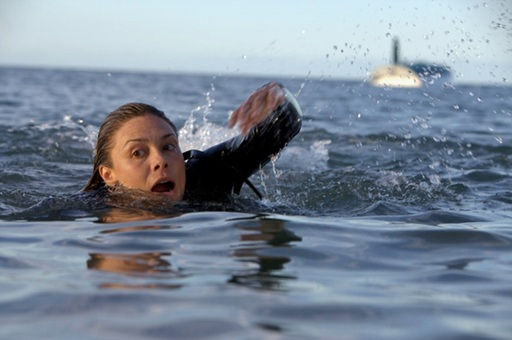
What elevates that feeling of exposure to pure, unadulterated terror is how authentic the threat feels. There's no massive CGI budget here. No rubber sharks. The Reef utilises real life shark footage, taken specifically for this film. You might assume that if a director has incredible high-definition real-life footage of a 14-foot great white, they'd want to show it off constantly to justify the effort. But the camera exercises incredible restraint. It doesn't linger on the shark. The tension doesn't come from long, spectacular, National Geographic-style shots of the animal. The tension is born entirely from the shark's constant, suffocating presence. You know it's there. You know it's circling the group. You know it's swimming somewhere underneath them in the dark, just waiting for the perfect opportunity to strike. It's the omnipresence of the threat. When the inevitable strikes actually do happen, they're brilliantly executed, relying heavily on that exact same principle of the unseen. Rather than relying on overt, gratuitous gore, the most gruesome details of the attacks are deliberately left off camera. The director forces the viewer's own imagination to fill in the blanks. The sound design of a splash, the sudden pull underwater, a scream - it doesn't take much imagination to feel every single bite chew and drag.

The film features a cast of largely unknown actors who do a highly competent job with the material they're given. However, they are given very little narrative depth. We basically learn their names, there's a very brief revelation about some shared romantic history between two of them, and that's about the extent of their character arcs. If we don't know who these people are, why should we care if they survive? But this goes back to what I discussed earlier about the film's stark departure from Open Water. As soon as these characters hit the water, an enormous primal shift occurs within the audience's psychology. We simply stop caring who they are, what they do for a living, where they come from or how they got there. It just doesn't matter anymore. All of that societal context instantly evaporates the moment the shark arrives because they've been reduced to prey. We are purely 100% invested in seeing how or if they're going to survive this raw physical predicament. When there's a literal monster circling beneath your feet, no one cares about your dramatic backstory or your unresolved childhood trauma. The narrative becomes purely mechanical, who swims fast enough, who panics, who stays quiet. It’s something I wish a lot of similar monster movies would return back to instead of forcing unnecessary sub-plots onto us.

But this lack of character depth does lead to an unfortunate flaw in The Reef's structure. Because the characters are too thinly drawn, they tend to fall into familiar, survival thriller archetypes. And because of that, it becomes easy to spot exactly which character is going to get eaten next. You can kind of mathematically guess the exact order in which they'll be picked off as the story progresses. When characters adhere too closely to certain archetypes (the panic-stricken one, the brave leader, the quiet one) the narrative mechanics become transparent to an audience that's well-versed in horror tropes. No matter how much the tension is successfully cranked up, knowing exactly who was going to die next definitely deflates some of the narrative suspense because you know which characters are carrying the plot armour. But don’t let this minor structural flaw ruin your experience. The constant, suffocating dread of the shark's unseen presence is enough to put the chills up absolutely anyone. This adds a crucial shred of terrifying unpredictability. Yes, you might deduce who's going to die next based on movie tropes, but you never, ever know exactly when it's going to happen.
Final Verdict
The Reef is highly effective, gripping in places and does a better job at cranking up tension and drama than 90% of big budget Hollywood films. You will feel just as isolated, helpless and waiting to die as the characters. Just don't expect to see something you haven't seen before.
 |
The Reef Director(s): Andrew Traucki Writer(s): Andrew Traucki Actor(s): Damian Walshe-Howling, Gyton Grantley, Adrienne Pickering, Zoe Naylor, Kieran Darcy-Smith, Mark Simpson Duration: 94 mins |  |
|---|


