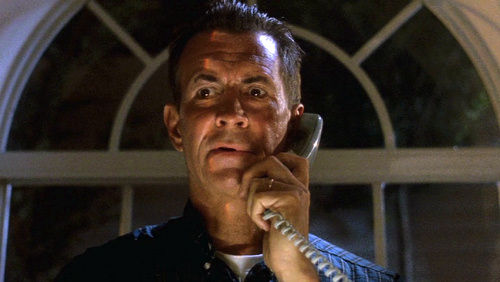
Tail Sting (2001)

"Don't fasten your seatbelt!"

Plot
A charter plane is carrying a cargo of genetically engineered scorpions. One of the passengers is actually a secret agent working for another company who have hired him to steal the research. During the theft, he accidentally frees the scorpions and they make their way through the plane, killing off passengers and crew. It's up to the remaining survivors to try and stop the scorpions from crashing the plane.
Review
When you hear the phrase ‘deadly creature escape on an airplane’, your mind probably jumps straight to the internet sensation Snakes on a Plane. But long before Samuel L. Jackson proclaimed he’d had enough of certain snakes on a certain plane, someone else had dreamt up the idea of letting loose a load of deadly creatures on a plane Tail Sting came along in 2001 and did one better than snakes - it set free some giant scorpions. The story sounds a lot more riveting on paper than it does on the screen, believe me. It's amazing how some films really try to blast through their limited budgets with visions of grandeur. Someone has got to try. For every Tail Sting, there's The Evil Dead or The Blair Witch Project, which captures lightning in a bottle and makes a ton of money. However, when a film has a budget this low and the idea of bringing giant scorpions to life, that sort of vision will turn into a nightmare soon enough. It's like watching someone try to build a fully functioning space shuttle out of cardboard boxes and duct tape in their back garden. You just have to admire the sheer blinding vision of the attempt, even as you watch the whole thing violently explode on the launch pad.

Tail Sting has a heart, but it hasn't got a pulse. The sets look cheap and most of the film is based around the same handful of them. Physics isn't one of the strengths of the script and the dimensions of the plane are blown out of proportion. Have you ever walked on to a typical commercial flight? You know they're tiny and you know how cramped they are. You can barely fit bags in the overhead compartments as they stand, let alone move around much in them. The cargo holds are a lot bigger but as most of us will never go in one in our lifetime, we only know what we can see from the size of the plane sitting on the tarmac as we get on. However, in Tail Sting, the cargo hold is depicted as this massive, cavernous warehouse of a space, like an industrial hanger. It is essentially a TARDIS from Doctor Who, but an airplane, and created entirely by accident. It's a direct result of low budget filmmaking mechanics. When you shoot a film like this, you rarely have the money to build a cohesive interconnected set so you rent a cheap warehouse for a day to shoot the cargo hold scenes, and then you rent or build a tiny pre-built airplane fuselage mock-up on a totally different soundstage for the passenger area scenes. The director just hopes the audience won't notice that the two spaces physically cannot exist inside the same aerodynamic vehicle.

The audience does notice, especially because that spatial confusion directly impacts the logic of the scorpions themselves. If these are supposed to be giant scorpions, how exactly are they navigating their way from that cavernous cargo hold up to the tiny cockpit through standard narrow airplane pipes and little air vents? It is physically impossible. You cannot fit a creature the size of a coffee table through a six-inch ventilation shaft. The shifting size of the creatures is handy from a narrative point of view because they can do anything and be anywhere the script needs the scorpions to be but from a common-sense approach, it beggars belief. How come in some scenes there's this huge tail striking down at a helpless victim, implying a truly gigantic beast, yet in others the scorpions are barely bigger than the seats and aisle? It kills any real attempts to generate fear and tension because you know the script can just do what it wants with the scorpions at any time, rather than giving the characters some breathing room or safe spaces for a few minutes. If the physical limitations and practicalities of the creatures become, well, unlimited, then you’re writing yourself into a box for when you need to figure out a way to combat them. The scorpions are supposed to be the stars of the show, yet they look rubbish. The scorpion on the front cover looks suitably menacing but we don't see much of them like that at all. You'll get a glimpse of a rubber tail for close-up shots of attacks and cheap-looking puppets are used for other shots. I admire the lack of CGI scorpions so I'm not going to mark it down for that. At least they tried to make the scorpions real. The problem here is that as soon as we see how pathetic and badly designed these creatures are, the whole thing descends into absurdity.

Everything else about the film is rather flimsy, weak and played strictly by the book. The story is contrived, even before Snakes on a Plane came out because all you're doing is swapping a space ship for a confined submarine to a warehouse or underground bunker. You know what is going to happen and at no point does the film become anything other than predictable and clichéd. There’s the rugged action man pilot who just happens to have a troubled past naturally, the feisty heroine who is initially hostile but is definitely going to learn to trust him, the old scientist whose only job is to spout ridiculous exposition about scorpion genetics, and the slimy corporate executive who is absolutely guaranteed to betray someone in the third act to save his own skin. Two Middle Eastern immigrants whose portrayal borders on being blatantly racist (and rather alarmingly, two Middle Eastern men who appear to have sinister motives, on a plane, in 2001...) are thrown in to the mix too. Most of the acting is bad but considering that there are no ‘named’ actors in display here, some of them are passable at best including both Robert Merrill and Laura Putney as the two leads.

You could argue that Tail Sting does a better job of sending up this creature feature genre than Snakes on a Plane. Tail Sting plays everything seriously and some wonderfully awful lines coupled with some straight-faced seriousness from the cast account for some truly dire moments of pure cheese. It's unintentional comedy but in many respects, it works better that way than the overly smug, smarmy self-awareness of Snakes on Plane, where the actors winked at the audience constantly and the dialogue was engineered to become internet memes. The creators and the actors of Tail Sting genuinely seemed to think they were making a serious, pulse-pounding, high-octane thriller. The cast are delivering these wonderfully absurd lines about minivan-sized arachnids hunting them through an airplane, and they are doing it with the grim, unwavering intensity of a Shakespearean tragedy. And that earnest delusion is the magical ingredient for true B-movie greatness. When you are trying so incredibly hard to be dramatic and serious, and you fail so spectacularly because a rubber tail keeps bumping into a cardboard wall, it creates an entirely different, vastly superior kind of entertainment. Not one that I’d want to watch again however!
Final Verdict
Tail Sting doesn't have any sting its tail at all. Lame, predictable and a waste of time and money. There is sheer ambition behind the scenes with the whole wild pitch of the film, but ultimately that ambition alone cannot save a project that lacks the fundamental execution to make it work – ultimately a decent budget and some people who know how to use it wisely.
 |
Tail Sting Director(s): Paul Wynne Writer(s): Timothy Griffin, Peter Soby Jr. Actor(s): Laura Putney, Robert Merrill, Shirly Brener, Gulshan Grover, Tara Price, Jean Carol, Elizabeth Perry, Joe Boony Duration: 93 mins |  |
|---|